HOW TO REALISE THE AGENTIC OPPORTUNITY IN HEALTHCARE
The internet is being rebuilt for AI, and every vertical is running experiments to find out what agents can do.
- Enterprises expect an average 171% ROI from agentic AI (PagerDuty, 2025).
- Gartner projects that 33% of enterprise software will ship with agentic AI by 2028, and
- 15% of day-to-day work decisions will be made autonomously by 2028, up from zero in 2024.
Healthcare could be among the fastest moving but has the highest stakes. A swarm of vendors is selling an agent that just handles the work: booking, messaging, triage, follow-up, around the clock. The pitch is compelling. The problem is that this work touches data, records, and patients.
Agentic AI is scaling fast across every vertical. In healthcare, the barrier to production is control.
Unicity could be what crosses the gap.
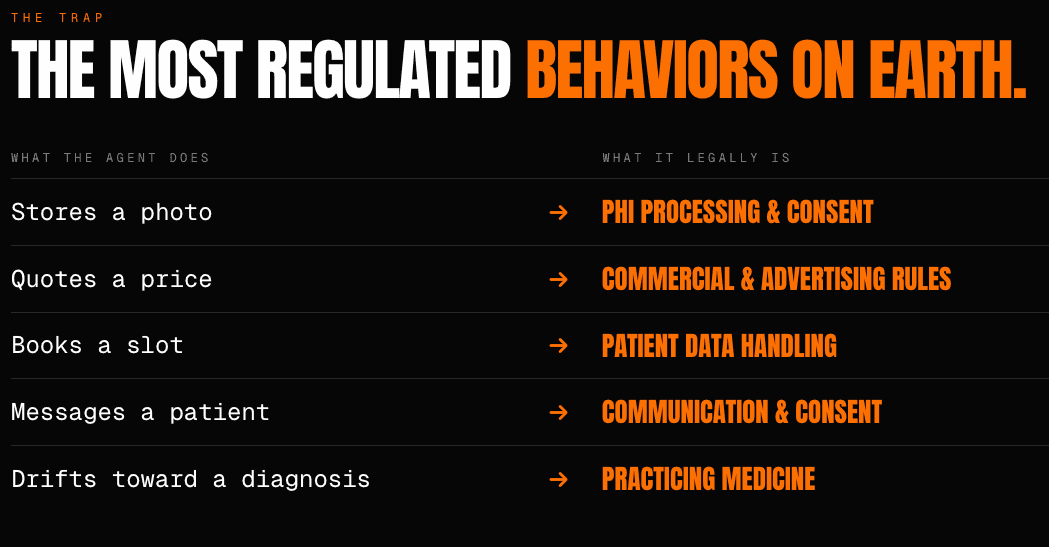
In a hospital, the most ordinary agent actions are the most regulated behaviours on earth. Store a photo and you are processing PHI. Book a slot and you are handling patient data. Drift toward a diagnosis and you are practising medicine.
The capability you are buying and the liability you are taking on are the same handful of actions.
The way most agents are controlled today is a prompt, and a prompt is bypassable. A clever patient, an edge case, or a model's own hallucinated confidence will eventually talk its way around a sentence of instructions.
One late-night conversation that ends in an unlicensed prescription can breach medical licensing, data consent, and cross-border transfer rules at once. The penalties do not substitute. They stack.
- Gartner expects 40% of agentic AI projects to be cancelled by the end of 2027, citing cost, unclear value, and inadequate risk controls.
- IBM found that 97% of organisations breached through AI lacked proper AI access controls, and 63% had no AI governance policy in place.
- The global average cost of a breach reached $4.44M, with a further $670K added when ungoverned shadow AI is involved.
The upside in healthcare is documentation burden and clinician retention. Ambient documentation has cut burnout prevalence by 21.2% at Mass General Brigham and raised documentation-related wellbeing by 30.7% at Emory.
Set against a physician replacement cost of roughly $500K to $1M, cutting that burden is a retention case with hard financials behind it. None of it reaches scale until the agent is safe to run.
The gate to production is control. Security that cannot be bypassed. An audit trail a regulator will accept. Data that stays in the region. Governance that is enforced, not documented after the fact.
Databricks reports that 12 times more AI projects reach production where active AI governance is in place. Governance is the gate, and most organisations are standing on the wrong side of it.
That is an architecture problem, not a policy problem. Guardrails written into a prompt live inside the model, where the model can be talked around. Enforcement has to sit below the model, in the layer the agent runs on.
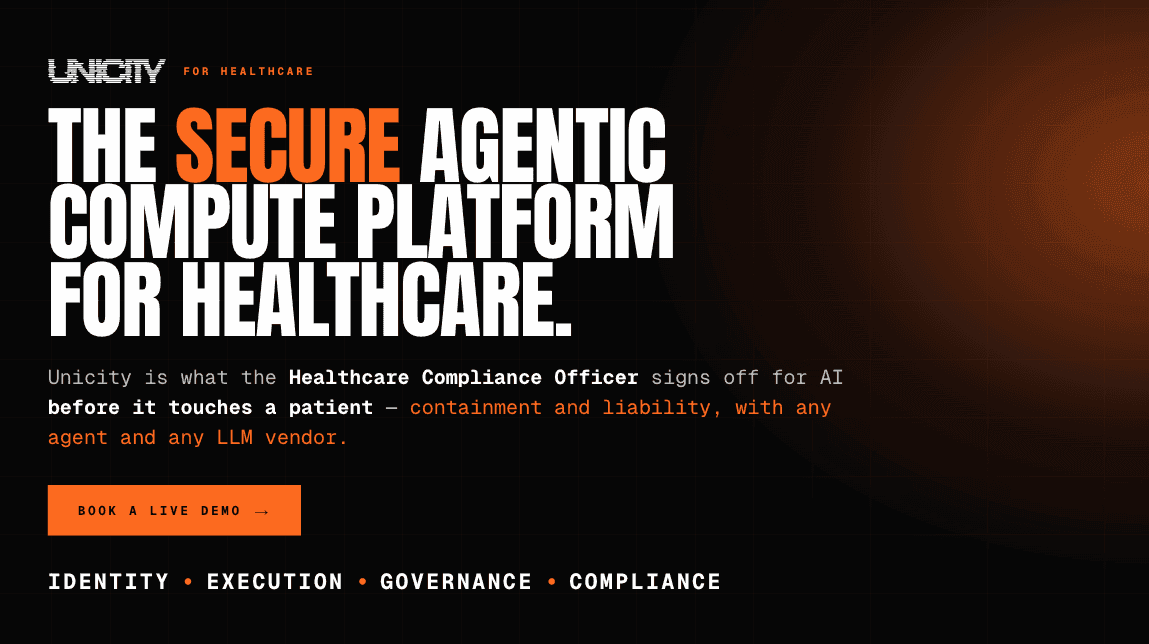
Unicity is a secure agentic compute platform for AI agents and the people that run them.
Our healthcare product acts as a layer that a hospital's compliance officer signs off before an agent touches a patient. Bring any agent, any framework, any vendor. Unicity makes it safe to run, without replacing your existing stack.
It works by moving enforcement to the kernel rather than with guardrails or with prompts.
Unicity AOS (Agent Operating System) runs every agent on your own infrastructure, on-premise or air-gapped, in an isolated sandbox.
Every prompt, tool call, and action passes through the Semantic Intercept Fabric, the agent firewall inside AOS, where policy, budgets, and human sign-off are enforced in-path.
A regulated action is stopped before it happens, not flagged afterwards. You cannot prompt-inject your way past a kernel boundary. Architecture beats policy.
Every regulated action then lands in a tamper-evident record. Rather than infer what an agent did from scattered logs, you hold one definitive, source-linked answer per action, which is exactly what an EU AI Act deployer is required to keep. The clinician stays the final arbiter, and the platform enforces that.
Unicity is built by the team behind Guardtime, the world's first nationally deployed blockchain, deployed into NATO, U.S. DoD including DARPA, Lockheed Martin, Estonian digital-state systems, and Verizon Enterprise.
This is a team that has shipped provable-integrity infrastructure into environments that do not tolerate failure.
Our Healthcare industry solutions page outlines more on the Unicity product solution for the heathcare industry.
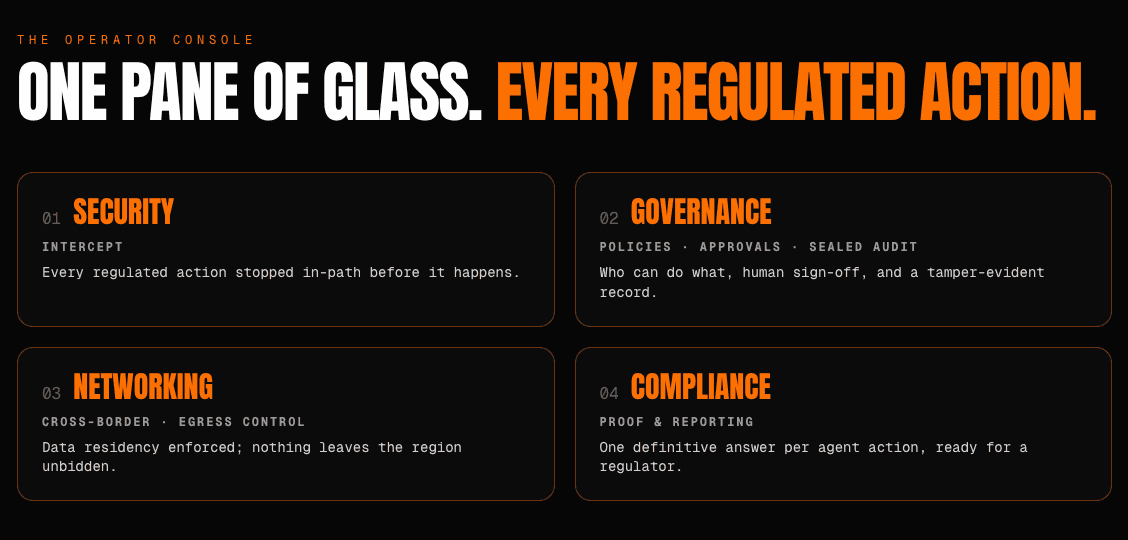
- Security | Every regulated action stopped in-path before it happens.
- Governance | Who can do what, human sign-off, and a tamper-evident record.
- Networking | Data residency enforced; nothing leaves the region unbidden.
- Compliance | Proof & reporting
One definitive answer per agent action, ready for a regulator.
Bring any agent, any LLM, any vendor. Unicity is the layer a hospital's compliance officer signs off on before it touches a patient - containment and liability, solved at the runtime.
See an agent hit a regulated boundary and get stopped, live, on your own infrastructure.
Book a demo, or reach us at info@unicity.ai.